
That small device we all carry around in our pockets began in 1876 as the first instrument to transmit sound electronically across wires — the telephone. Its inventor, Alexander Graham Bell, was a Boston University professor at the time. Famously, the first words spoken into the telephone were by Bell to his assistant, Thomas Watson: “Mr. Watson, come here – I want to see you.” Watson did indeed promptly appear.
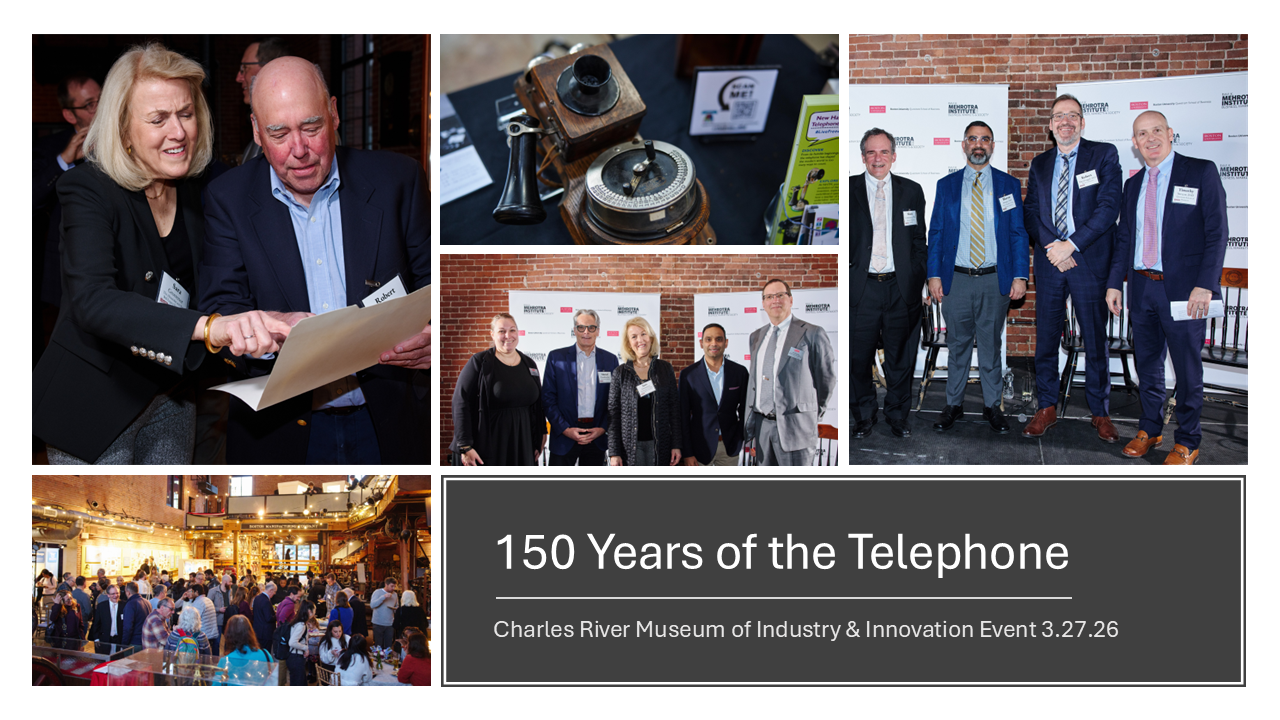
It’s been 150 years since that groundbreaking invention, and on March 27, the Mehrotra Institute marked this milestone by holding two events. The evening’s event was at Waltham’s Charles River Museum of Industry & Innovation. We celebrated both the telephone itself and its long history and ever evolving future — as well as the important legacy of innovation that is fostered by universities. It is noteworthy that this event marked the first time that descendants of Bell and Watson were brought together, highlighting the fact that, as moderator Jay Zagorsky said, without Watson, Bell’s ideas could not have been made practical.
In commemorating this remarkable invention and patent, we also acknowledged the complicated history of the man himself. Bell was a brilliant inventor, but he was also a man whose publicly professed views on human differences caused real and lasting harm to the deaf community, a history that remains relevant to our own community of students, faculty, and staff involved in deaf education.
The story of the telephone patent is not linear, and at the start, its future impact was unknown. Businesses, lawyers, innovators, and ordinary people all played a part in transforming the original idea into the reality we know today. At the heart of our work at the Mehrotra Institute, we examine this complex interplay among businesses, markets, and institutions and how these players shape innovation and help translate discovery into the sort of economic and societal change that impacts our world for the better.
The Telephone at 150: Innovation, Society, and Change at the Charles River Museum
The Charles River Museum of Industry & Innovation was the perfect setting for this historical commemoration. The New Hampshire Telephone Museum brought old telephones to exhibit and Alexander Graham Bell documents from the Boston University archives were also on display.
Two panel discussions framed the evening event. The first centered the history and future of the telephone and featured comments by:
- Sowmyanarayan Sampath, CEO Verizon Consumer
- Sara Grosvenor, Bell’s great-granddaughter and President of the Alexander and Mabel Bell Legacy Foundation
- Jay Zagorsky (moderator), Questrom clinical associate professor of Markets, Public Policy, and Law
Grosvenor provided personal perspectives about Bell: that he wouldn’t have a phone in his office (too distracting); he liked to skinny dip at night on his back smoking his cigar; and that he and his wife Mabel were progressive — they supported universal suffrage, protested against racial segregation, and moved to Nova Scotia so their daughters could wear pants. She said that Bell would tell young inventors to be curious, passionate, and persistent. Sampath gave a taste of the future and said that everything would be connected eventually, even our chairs and that we’ve solved most of the complexity that tech provides, but billing is still too complex for consumers to understand. He emphasized that if America wants to be competitive long-term, it has to fund fundamental research. Both panelists talked about how the phone helps to provide human connection and breaks down distances.
The second panel dove into issues surrounding commercialization of university technology and featured comments by:
- Robert MacDougall, associate professor of history, Western University Ontario
- Bhaven Sampat, research professor of economics, Johns Hopkins University
- Shane Greenstein, professor of business administration, Harvard Business School
- Tim Simcoe (moderator), Questrom professor of strategy and innovation
The distinction between invention and innovation is important: invention can only become innovation through investment — likewise, real innovations, true paradigm shifters are almost always unexpected. We borrow ideas from others, and we don’t always know what the impact of an invention will be. For example, the telephone exploded in use only after the original Bell patent expired and innovators were able to experiment with the technology. Historically, universities were reluctant to get involved in patents but now technology transfer offices exist to ensure that technology makes it to market.
Watch the recording of both panels here.
And check out photos from the event here.
Invention and Patent Battles at Questrom
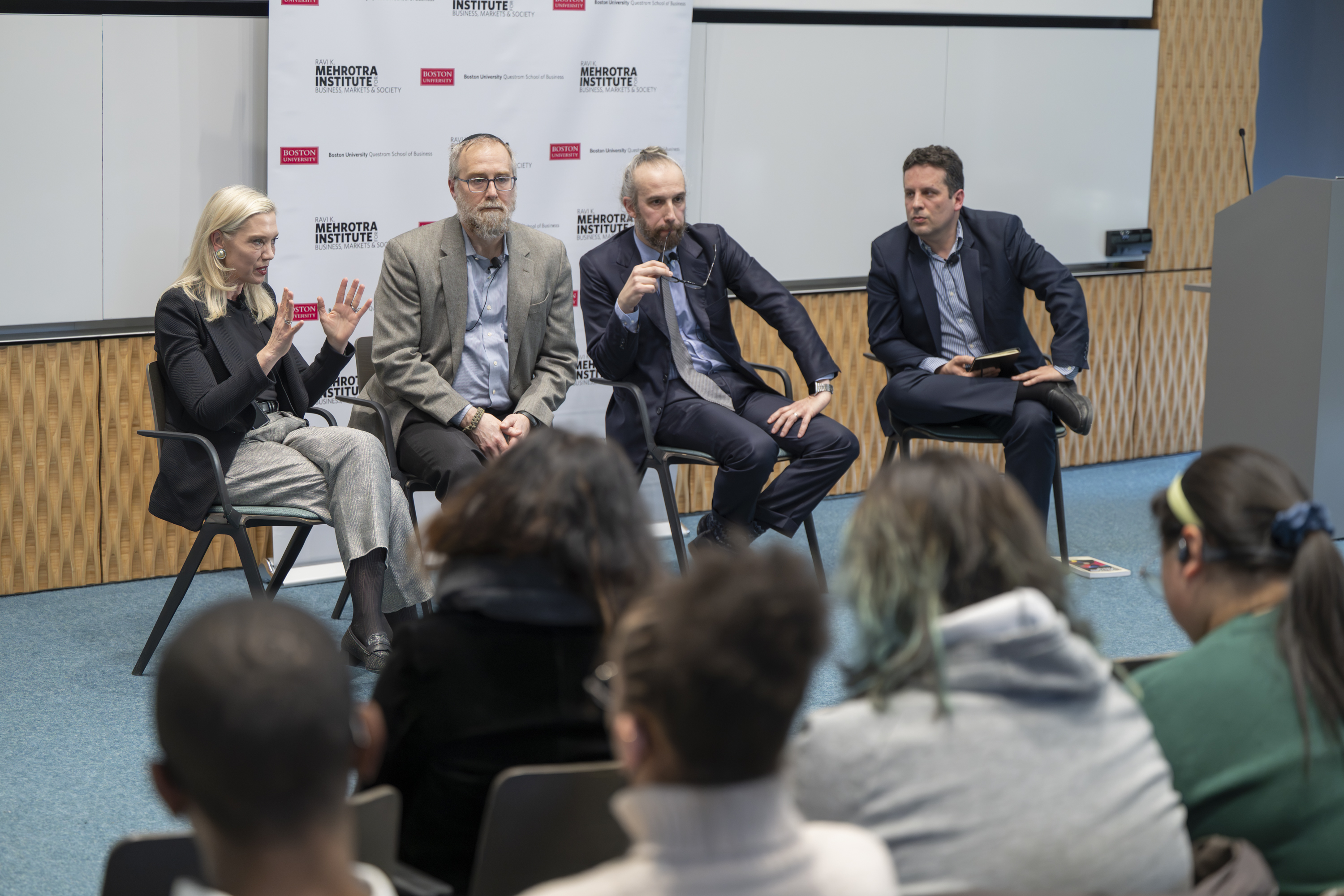
The day-long event began at Questrom with an academic poster session by students and a panel discussion about inventions and the patent battles that often surround them.
Panelists included:
- Christopher Beauchamp, Brooklyn Law School professor and author of Invented by Law: Alexander Graham Bell and the Patent That Changed America
- John Duffy, University of Virginia law professor
- Adam Jaffe, former director of Motu and author of Patents, Citations and Innovations: A Window on the Knowledge Economy and Innovation and Its Discontents: How Our Broken Patent System is Endangering Innovation and Progress and What to Do About It
- Megan MacGarvie (moderator), Questrom associate professor of Markets, Public Policy, and Law
We might not have had the telephone without the patent system, and this panel dove into the impact of patents both in Bell’s time and now. The role of patents is myriad: bringing money and ideas together; protecting investment; allowing trade in technology ideas; protecting new, useful, and nonobvious inventions; and giving inventors the freedom to specialize in inventing, rather than forming companies. The 1980 Bayh-Dole act allowed universities to patent ideas that came out of their federally-funded research and the technology transfer office was born. Today, patents are different for big entities vs. small entities and are more important in setting up or selling a business.
And stay tuned for the May 29 live taping of our podcast, Is Business Broken? as part of the WBUR Festival. The topic? We’ll return to the theme of invention and innovation as we continue to celebrate this important milestone.