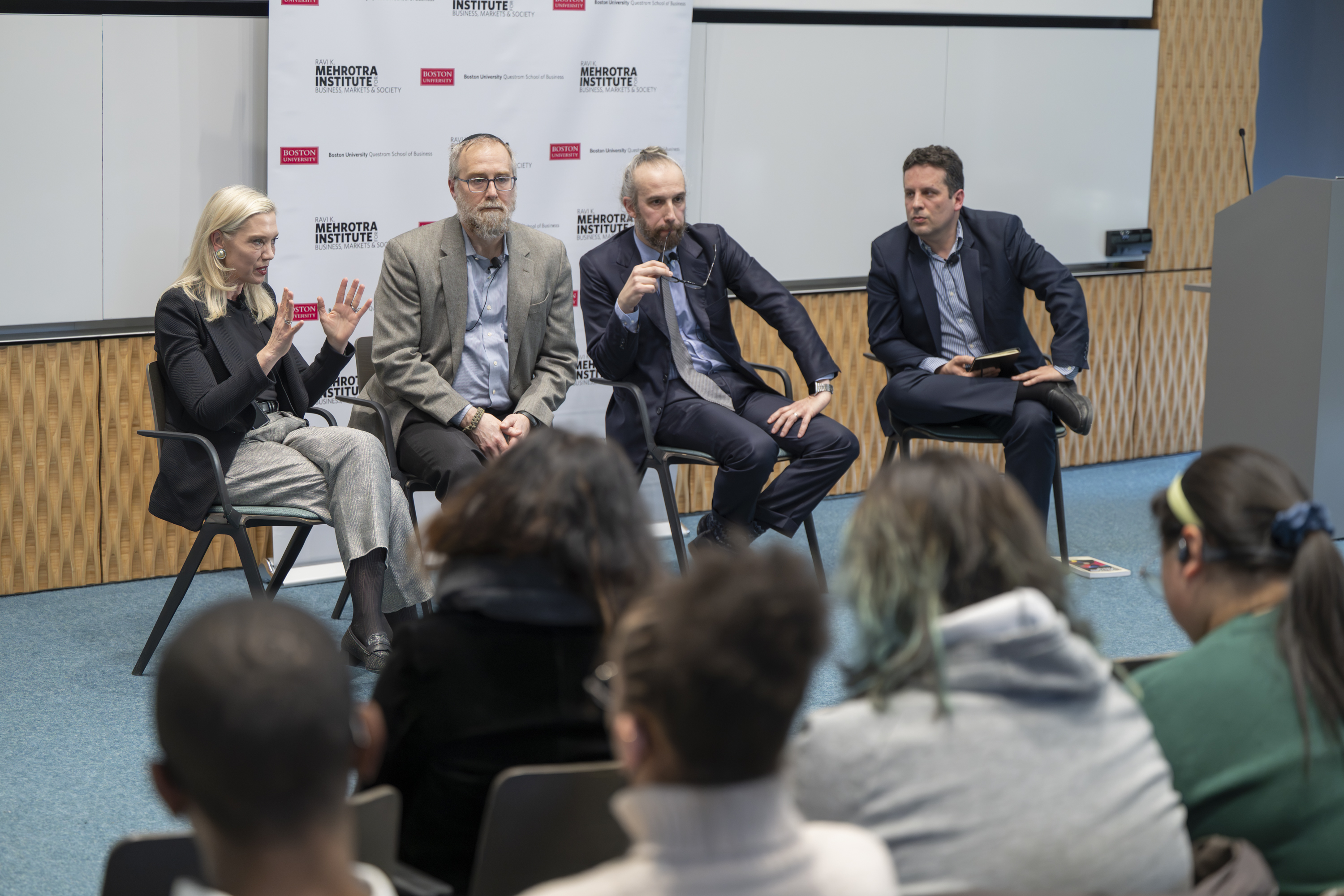

Because businesses are such an integral part of our society, how they are run and in particular, how they respond to external risks matter. Our recent “Corporations in Politics” discussion dove into how corporations approach the new paradigm of managing political risk as a core business function.
Panelists for this event included Jane Adams, Senior VP at Johnson & Johnson; Matteo Gatti, Rutgers Law School Professor; and David Webber, BU Law Professor. The panel was moderated by corporate governance expert Roy Shapira, a visiting Questrom professor from Harry Radzyner Law School in Israel.
Adams emphasized that companies have to engage with any administration and that there are a lot of board-level discussions about the risks and benefits of weighing in on a given issue. She added that Johnson & Johnson often thinks about “what does our voice offer to the dialogue?” and focuses on adding their voice on topics related to patient outcomes, scientific evidence, and cures and treatments.
Gatti cited his book, Corporate Power and the Politics of Change, which looks both at how companies are now making policy where government institutions have fallen short and how companies are talking about political issues when they engage with politicians. He said that in the face of political pressure, he sees corporations falling into one of three buckets: some have reversed policies publicly, some have stood their ground, and some are quiet but are rebranding, for example they don’t say DEI anymore, but are instead using similar words. He also pointed out that for large corporations like Johnson & Johnson, the entire world is potentially a customer, but for others with a smaller niche, some level of controversy can be good for a company’s image.
In response to a question about divestment, Webber said that he’s skeptical about using that as a tool because there’s little evidence that it works and he likened it to not voting in elections – those who remain as investors have all sorts of rights, including the right to vote on corporate matters and the right to sue a company.
Want more? Watch the recording here.